
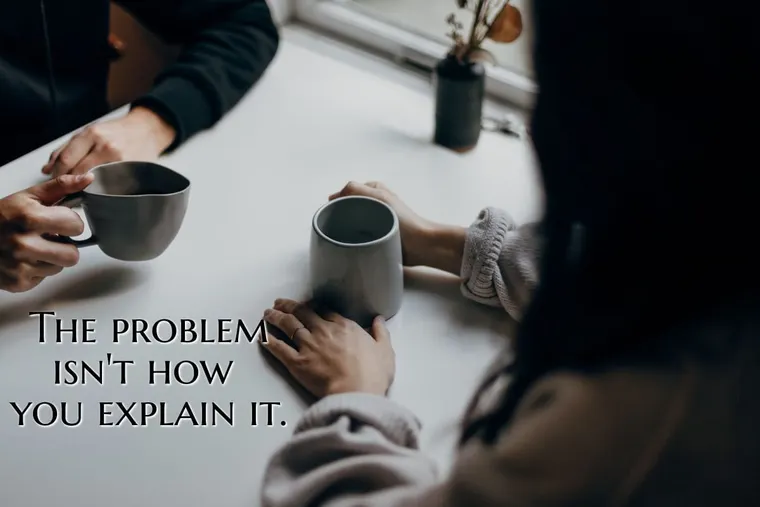
I bet this has happened to you.
You're sitting across from a friend drinking coffee. Out of the blue, he asks you about the connection between wheat prices and regime overthrow.
You look up, excited. You spent a year in Africa studying just this topic. You know all of the research and are friends with experts. In fact, you're in the middle of reading that book everyone told you about.
The question launches you into a discourse that has the person looked confused.
So you dumb down what you're saying. You talk and talk. After all he asked.
But he just get more silent. Their face becomes a mask of something — boredom? judgement? Is that contempt on their face?
Uncomfortable, you stop talking.
Did you get the question wrong? Isn't this what he wanted to talk about?
You ask the person, and he nods. Yes, that's what he asked.
You sit in silence wondering what to do next. The person eventually makes their excuses and leaves.
Your uncomfortability continues. What did you do to offend your companion? You did talk a lot. Were you being narcissistic? But wait, he asked you about something you know a lot about! Why did he ask? Your mother always said that men couldn't handle a smart woman. Why hadn't you remembered??
On and on, your mind spins.
You tried to explain your thoughts but that just seemed to turn them away from you.
From this point, you may start to make up rules.
- You're never going to meet with friends again.
- You will do better in your next conversation with this person.
- You're going to...
You're not sure what you're going to do, but it will be better next time.
This happens to all of us.
Here's a bit of hard truth.
The problem wasn't your explanation.
The problem is that you are ready and excited to have a deep, layered, knowledge-based conversation on a topic you know a lot about.
The situation – meeting a friend for coffee – is a light surface-level exchange.
There's a mismatch between what you, your friend, and the situation itself.
You didn’t explain it wrong.
You just tried to have the wrong kind of conversation.
And no amount of explaining fixes that.
What should you do next time?
When someone brings up a topic you know a lot about, make sure to ask them what they think about that topic. After they tell you, tell them of your expertise, and ask them:
Do you want the short version? Or the longer more complicated version?
Put away your inner know-it-all. Be curious. You're not there to win an award or get a research grant. You're there to connect with someone you care about.
Not every conversation can carry depth.
When you treat it like it can, you create friction and misdiagnose the problem.
So, the next time you feel yourself talking more and more – stop!
This is your real-life clue that the conversation isn't serving you, your friend, or the situation.
Not because you’re saying it wrong, but because the conversation can’t support what you’re trying to say.
